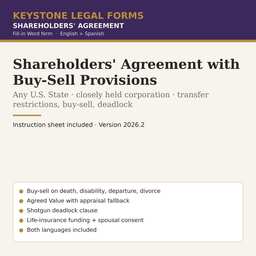
Shareholders' Agreement with Buy-Sell Provisions — Any State
For the owners of a closely held corporation: supermajority decisions, transfer restrictions, buyout on death, disability, departure or divorce, agreed-value pricing, life-insurance funding, shotgun deadlock clause. 51 state editions included.
Who it is for
The two to several owners of a closely held corporation who want to decide now who may own shares, how major decisions are made, and what happens to an owner's shares on death, disability, departure, bankruptcy or divorce — with a price mechanism that works and life-insurance funding.
What is inside
- Shareholders' Agreement: Key Terms table + 10 articles — board designation and officers, Major Decisions with supermajority, certificate legend, transfer restrictions and right of first refusal, permitted transfers, preemptive rights, buy-sell events (death, disability, termination, bankruptcy, divorce, withdrawal), mandatory purchase on death, options and put, fault discount, Agreed Value and three-appraiser fallback, payment terms and pledge, life-insurance funding with Section 101(j) consent, deadlock mediation and shotgun buy-sell, non-competition and confidentiality, S corporation protection and tax distributions
- Schedule A shareholder register · Schedule B annual Certificate of Agreed Value · Schedule C Spousal Consent · Schedule D Joinder for new shareholders · Schedule E promissory note for an installment buyout
- Instruction Sheet: supermajority design, how to set and update the Agreed Value, entity purchase vs cross-purchase insurance, triggering events and the put, the shotgun clause, S corporation traps, community-property spouses, after-signing checklist, when the form is not enough
The first pages
Rendered from the actual form. Yellow fields are the ones you fill in; the rest is already written.
SHAREHOLDERS' AGREEMENT
[CORPORATION NAME]
The information in this table is incorporated into the Agreement that follows. Where the Agreement refers to an item "in the Key Terms," it means the entry below.
| Item | Entry |
|---|---|
| Corporation | [CORPORATION NAME], a [STATE OF INCORPORATION] corporation, state file no. [STATE FILE NUMBER], with its principal office at [PRINCIPAL OFFICE ADDRESS] |
| Effective date | [EFFECTIVE DATE] |
| Shareholders and shares (Schedule A) | The persons listed in Schedule A, holding the number and class of shares shown there. Schedule A is updated each time shares are issued or transferred. |
| Total shares outstanding | [TOTAL SHARES OUTSTANDING] shares of [CLASS OF SHARES — e.g., "common stock"] |
| Number of directors | [NUMBER OF DIRECTORS]; each Shareholder holding at least [MINIMUM PERCENTAGE TO NAME A DIRECTOR]% of the shares may designate one director |
| Major Decisions require | The approval of Shareholders holding at least [MAJOR DECISION PERCENTAGE]% of the shares (Section 2.4) |
| Agreed Value of the Corporation | $[INITIAL AGREED VALUE] as of the Effective Date, to be updated each year under Section 5.1 (Schedule B) |
| Payment of the purchase price on a buy-sell event | [DOWN PAYMENT PERCENTAGE]% in cash at closing; the balance by promissory note payable in [NUMBER OF ANNUAL INSTALLMENTS] equal annual installments with interest at [NOTE INTEREST RATE]% per year (Section 6.1) |
| Life insurance funding | [TYPE "Yes — the Corporation will maintain a policy on the life of each Shareholder in the amount of $" AND THE AMOUNT OR "None"] |
| Non-competition while a Shareholder | [NON-COMPETE: "Yes — no Shareholder may compete with the Corporation in the State of [GOVERNING LAW STATE] without the written consent of a majority of the other Shareholders" OR "No — Shareholders may engage in competing businesses"] |
| Non-competition after a sale of shares | [TYPE "None" OR "Yes — for" AND THE NUMBER OF MONTHS "months within" AND THE TERRITORY] |
| Tax status of the Corporation | [TYPE "S corporation — the Shareholders will preserve the election (Article 9)" OR "C corporation"] |
| Shareholder's spouse (if a Shareholder is married and lives in a community property state) | Each married Shareholder's spouse signs the Spousal Consent in Schedule C |
| Governing law | State of [GOVERNING LAW STATE] |
… the document continues for about 14 pages.
The instruction sheet
Every download includes a plain-language instruction sheet. This is how it opens.
INSTRUCTION SHEET
Shareholders' Agreement with Buy-Sell Provisions
This is the agreement among all the owners of a small corporation — two to a handful of shareholders who also run the business — about three things the corporation's charter and bylaws do not settle: who decides what; who may own shares; and what happens to a shareholder's shares when he or she dies, becomes disabled, leaves, goes bankrupt, divorces or simply wants out. Without it, a deceased partner's shares pass to whoever inherits them, a departing partner can sell to a stranger, a divorce court can award shares to an ex-spouse, and two 50% owners who disagree have no way to break the tie.
Why a written agreement matters. Every state's corporation statute lets shareholders of a closely held corporation agree among themselves on these matters, and courts enforce the agreement against the shareholders, their estates and anyone who acquires shares with notice of it. A bank or buyer will ask for it. Life insurance to fund a buyout cannot be arranged sensibly without it. And the "agreed value" mechanism in Article 5 is the simplest way a small company has to fix a price before a dispute makes agreement impossible.
Use this form if: the corporation has two or more shareholders, all of whom will sign; the shareholders are individuals (or their trusts or holding companies); and the shares are not publicly traded. It works for a C corporation or an S corporation.
Use a different form if: the business is a limited liability company (use the operating agreement forms, which contain the equivalent buy-sell provisions); there is only one shareholder; the corporation has outside investors with preferred stock, or a class of shares with different rights (the Key Terms assume one class); or the shareholders are themselves large companies. For the sale of a shareholder's shares to another shareholder when no agreement exists, an attorney should prepare the purchase agreement.
• Work in Microsoft Word (or any program that opens .docx files). Every field appears in yellow highlight inside square brackets, for example [CORPORATION NAME]. Replace the whole bracket — including the brackets — with your information, and remove the highlight if you wish. Use Find and Replace for names that appear many times.
• Some fields offer choices, written as "OPTION A" OR "OPTION B", or begin with the word TYPE followed by the alternatives. Pick one, type that text in place of the entire bracket, and delete the alternatives. Never leave both options in the signed document.
• Fill in the Key Terms table first. Nearly every business decision the agreement needs is made there; the articles then refer to it.
• Schedules A and B are always used. Schedule C is used for each married shareholder; Schedule D when someone later acquires shares; Schedule E when a buyout is paid over time. Delete the cover page before signing.
State editions
All 51 editions are in the same download. Open a state to see what its edition already fills in.
AL · AK · AZ · AR · CA · CO · CT · DE · DC · FL · GA · HI · ID · IL · IN · IA · KS · KY · LA · ME · MD · MA · MI · MN · MS · MO · MT · NE · NV · NH · NJ · NM · NY · NC · ND · OH · OK · OR · PA · RI · SC · SD · TN · TX · UT · VT · VA · WA · WV · WI · WY
Questions
What file do I get?
A zip with the state-neutral form and all 51 state editions as Word (.docx) files in English and Spanish, plus the Instruction Sheet. Open in Microsoft Word, Google Docs or LibreOffice.
How do I complete it?
Open the Instruction Sheet first. Replace each yellow [BRACKETED FIELD] with your information, delete the options you do not use, delete the cover page, then print or e-sign.
Can I reuse it?
Yes. The license covers your own business and every company you own; it does not allow resale of the template itself.
Do I need a notary or a lawyer?
The Instruction Sheet says when a signature needs a notary and lists the situations where the form is not enough and an attorney should review it.
Refunds?
Digital downloads are final once delivered. The preview on this page is taken from the actual document so you can see what you are buying.