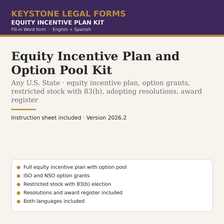
Equity Incentive Plan and Option Pool Kit — Any State
Everything a private corporation needs to reserve an option pool and grant equity that vests: a full Equity Incentive Plan (incentive and non-qualified options, restricted stock, repurchase rights, change-in-control rules with optional double trigger, 409A and Rule 701 provisions); board resolutions and shareholders' consent adopting it and setting fair market value; a Stock Option Grant Notice, Option Agreement and Exercise Notice; a Restricted Stock Purchase Agreement with stock power, Section 83(b) election and spousal consent; and an Award Register with pool reconciliation. 51 state editions.
Who it is for
A privately held corporation that wants to reserve an option pool and grant stock options or vesting shares to employees, officers, directors, consultants and advisers — founders at formation, a first key hire, or a company that cannot pay market salaries and wants its people to think like owners.
What is inside
- Equity Incentive Plan: pool size and share recycling, administration and optional CEO delegation, eligibility, incentive and non-qualified options (fair-market-value pricing, 110% rule for 10% holders, ten-year term, default four-year vesting with one-year cliff, $100,000 ISO limit, exercise methods, early exercise, post-termination periods, Cause), restricted stock with repurchase right and escrow, transfer restrictions (right of first refusal, lock-up, optional drag-along), Change in Control with optional double trigger, taxes and 409A, adjustments, Rule 701, term and amendment
- Board Resolutions and Shareholders' Consent adopting the Plan, reserving the pool, approving the award forms, setting fair market value, making initial grants and authorizing officers · Stock Option Grant Notice with key-terms table, Option Agreement (vesting, exercise, expiration, tax acknowledgments, transfer restrictions, legends) and Exercise Notice
- Restricted Stock Purchase Agreement with vesting, repurchase right, escrow, transfer restrictions and investment representations · Stock Power signed in blank · Section 83(b) Election with filing instructions · Consent of Spouse · Award Register with pool reconciliation · Instruction Sheet explaining 409A valuations, ISO vs NSO, the 83(b) election, Rule 701, vesting and acceleration, and the after-grant checklist
Contents of the document
Every article in the file you receive, in order. About 15 pages in Word.
- DOCUMENT 1 — [PLAN YEAR] EQUITY INCENTIVE PLAN
- DOCUMENT 2 — RESOLUTIONS OF THE BOARD OF DIRECTORS AND CONSENT OF THE SHAREHOLDERS
- PART A — UNANIMOUS WRITTEN CONSENT OF THE BOARD OF DIRECTORS
- PART B — WRITTEN CONSENT OF THE SHAREHOLDERS
- DOCUMENT 3 — STOCK OPTION GRANT NOTICE AND AGREEMENT — [CORPORATION NAME] [PLAN YEAR] EQUITY INCENTIVE PLAN
- PART A — GRANT NOTICE
- PART B — OPTION AGREEMENT
- PART C — EXERCISE NOTICE
- DOCUMENT 4 — RESTRICTED STOCK PURCHASE AGREEMENT — [CORPORATION NAME] [PLAN YEAR] EQUITY INCENTIVE PLAN
- PART B — STOCK POWER (SIGNED IN BLANK FOR ESCROW)
- PART C — ELECTION UNDER SECTION 83(b) OF THE INTERNAL REVENUE CODE
- PART D — CONSENT OF SPOUSE
- DOCUMENT 5 — AWARD REGISTER — [CORPORATION NAME] [PLAN YEAR] EQUITY INCENTIVE PLAN
The first pages
Rendered from the actual form. Yellow fields are the ones you fill in; the rest is already written.
DOCUMENT 1
[CORPORATION NAME]
[PLAN YEAR] EQUITY INCENTIVE PLAN
1. Purpose. The purpose of this [PLAN YEAR] Equity Incentive Plan (the "Plan") of [CORPORATION NAME], a [STATE OF INCORPORATION] corporation (the "Company"), is to attract, retain and motivate employees, officers, directors, consultants and advisers of the Company and its subsidiaries by giving them an ownership interest in the Company through awards of stock options and restricted stock, and to align their interests with those of the shareholders.
2. Definitions. "Award" means an Option or a Restricted Stock award. "Board" means the Board of Directors of the Company, or the committee to which the Board delegates administration of the Plan. "Change in Control" means (a) a merger or consolidation after which the shareholders of the Company immediately before it hold less than fifty percent (50%) of the voting power of the surviving entity; (b) a sale of all or substantially all of the Company's assets; or (c) the acquisition by any person or group, other than existing shareholders, of more than fifty percent (50%) of the Company's voting power; but not a financing in which the Company issues shares for capital. "Code" means the Internal Revenue Code of 1986, as amended. "Common Stock" means the [common] stock of the Company. "Disability" means a condition under which the Participant is unable to engage in any substantial gainful activity by reason of a medically determinable impairment expected to result in death or to last at least twelve (12) months, within the meaning of Section 22(e)(3) of the Code. "Fair Market Value" means the value of a share of Common Stock determined in good faith by the Board, in a manner consistent with Section 409A of the Code and, for Incentive Stock Options, Section 422, [by reference to an independent appraisal obtained not more than twelve (12) months earlier and updated after any material event]. "Incentive Stock Option" or "ISO" means an Option that qualifies under Section 422 of the Code. "Non-Qualified Stock Option" or "NSO" means an Option that is not an ISO. "Option" means a right to buy shares of Common Stock at a fixed price under the Plan. "Participant" means a person who holds an Award. "Restricted Stock" means shares of Common Stock issued under the Plan subject to vesting and a repurchase right. "Service" means employment with, or service as an officer, director, consultant or adviser to, the Company or a subsidiary; Service does not end on a transfer among them or on an approved leave of absence.
3. Shares Subject to the Plan. The total number of shares of Common Stock that may be issued under the Plan is [POOL SIZE] shares (the "Pool"), [being approximately POOL PERCENTAGE% of the fully diluted shares on the date of adoption], subject to adjustment under Section 11. Shares subject to an Award that expires, is forfeited, is cancelled or is repurchased by the Company at cost, and shares withheld to pay an exercise price or taxes, return to the Pool. All shares in the Pool may be issued as ISOs. Shares issued may be authorized but unissued shares or treasury shares.
4. Administration. The Board administers the Plan. It has full authority to select Participants; to determine the type, size, price, vesting and other terms of each Award, consistent with the Plan; to approve the forms of Award agreements; to interpret the Plan and the agreements; to accelerate vesting, extend post-termination exercise periods (within the limits of the Code) and waive conditions; to adopt rules; and to make every determination needed to administer the Plan, all of which are final and binding. No member of the Board is liable for any good-faith action under the Plan, and the Company indemnifies the members against claims arising from administration of the Plan to the extent the bylaws and the law allow. [The Board may delegate to the Chief Executive Officer authority to grant Awards to employees who are not officers, within limits the Board sets, OR DELETE]
5. Eligibility. Employees, officers and directors of, and consultants and advisers who render bona fide services to, the Company or a subsidiary are eligible for Awards. ISOs may be granted only to employees of the Company or a subsidiary. A consultant or adviser is eligible only if the services are not in connection with the offer or sale of securities in a capital-raising transaction and do not promote or maintain a market for the Company's securities.
6. Options. (a) Grant. Each Option is evidenced by a Grant Notice and Agreement stating whether it is an ISO or an NSO, the number of shares, the exercise price, the vesting schedule and the expiration date. (b) Exercise price. Not less than one hundred percent (100%) of Fair Market Value on the date of grant; for an ISO granted to a person who owns more than ten percent (10%) of the voting power of the Company (a "Ten Percent Holder"), not less than one hundred ten percent (110%). (c) Term. No Option may be exercised more than ten (10) years after grant (five (5) years for an ISO granted to a Ten Percent Holder). (d) Vesting. As the Grant Notice provides; unless it provides otherwise, [twenty-five percent (25%) on the first anniversary of the vesting commencement date and the balance in thirty-six (36) equal monthly installments thereafter], subject to continued Service. (e) ISO limit. To the extent the aggregate Fair Market Value (determined at grant) of shares for which ISOs first become exercisable by a Participant in any calendar year exceeds one hundred thousand dollars ($100,000), the excess Options are NSOs. (f) Exercise. By written or electronic notice in the form the Board approves, with payment of the exercise price in cash or check [, by surrender of shares of Common Stock owned by the Participant valued at Fair Market Value, by net exercise (withholding shares otherwise issuable), by a promissory note to the extent the law allows, or by any other method the Board approves]. Shares are issued only after payment, satisfaction of withholding, and the Participant's signature of the Shareholders' Agreement or the transfer-restriction agreement the Board requires. (g) Early exercise. The Board may permit an Option to be exercised before it vests, in which case the shares are Restricted Stock subject to a repurchase right at the exercise price that lapses on the Option's vesting schedule. (h) Termination of Service. Unless the Grant Notice provides otherwise, on termination of Service the unvested portion of an Option expires immediately, and the vested portion may be exercised for [three (3) months] after termination (twelve (12) months after termination by reason of death or Disability), but not after the expiration date; on termination for Cause the entire Option expires immediately. "Cause" means the Participant's dishonesty, fraud, embezzlement, conviction of a felony, material breach of an agreement with the Company, gross misconduct, or willful failure to perform duties after notice, as the Board determines in good faith [, or as defined in the Participant's employment agreement].
7. Restricted Stock. (a) Issuance. The Board may issue shares of Common Stock subject to vesting under a Restricted Stock Purchase Agreement, for a purchase price [not less than Fair Market Value OR of not less than the par value, as the Board determines] payable in cash, past services or other consideration the Board accepts. (b) Repurchase right. Unvested shares are subject to the Company's right to repurchase them at the lower of the purchase price paid and Fair Market Value on termination of Service, exercisable within [ninety (90) days] after termination, and are held in escrow until vested. (c) Rights. A holder of Restricted Stock has the rights of a shareholder, including voting and dividends, subject to the restrictions, [except that dividends on unvested shares are held and paid when the shares vest, OR DELETE]. (d) Section 83(b). The Participant is solely responsible for filing any election under Section 83(b) of the Code within thirty (30) days after issuance and for the tax consequences of filing or not filing it.
8. Transfer Restrictions. An Option may not be transferred except by will or the laws of descent and distribution and may be exercised during the Participant's lifetime only by the Participant [, except that the Board may permit transfer of an NSO to a family member or a family trust for estate-planning purposes]. Shares issued under the Plan are subject to the Shareholders' Agreement of the Company, if any, and in any event to: (a) a right of first refusal in favor of the Company and then the other shareholders on any proposed transfer, on the terms the Award agreement states; (b) a lock-up of up to one hundred eighty (180) days in connection with a public offering; (c) [a drag-along obligation to join a sale of the Company approved by the holders of DRAG PERCENTAGE% of the outstanding shares, OR DELETE]; and (d) the securities-law legend. The Board may also require that the Participant grant a proxy or power of attorney to the Company's designee to vote the shares on matters relating to a Change in Control.
9. Change in Control. On a Change in Control the Board may, in its discretion and without the Participant's consent, provide that outstanding Awards are (a) assumed or substituted by the successor on equivalent terms; (b) cancelled in exchange for payment of the amount, if any, by which the per-share consideration exceeds the exercise price, multiplied by the vested shares [and, for unvested shares, a right to the same payment on the original vesting schedule subject to continued Service]; (c) accelerated in whole or in part, including automatically if the successor does not assume them; or (d) terminated if not exercised before the closing after notice. [In addition, if within twelve (12) months after a Change in Control a Participant's Service is terminated by the successor without Cause or by the Participant for Good Reason, the Participant's Awards vest in full ("double trigger"); "Good Reason" means a material reduction in base pay or a relocation of more than fifty (50) miles without consent, after notice and a thirty (30)-day cure period, OR DELETE]
10. Taxes. The Company may withhold from any payment to a Participant, or require the Participant to pay, the amount needed to satisfy federal, state and local tax withholding on an Award, and may permit withholding of shares valued at Fair Market Value for that purpose up to the maximum statutory rate. The Plan and every Award are intended to comply with or be exempt from Section 409A of the Code and will be interpreted accordingly; the Company does not guarantee any tax treatment and is not liable for any tax a Participant incurs.
11. Adjustments. If the outstanding Common Stock is changed by a stock dividend, split, reverse split, recapitalization, reclassification or similar event without consideration, the Board will adjust the Pool, the number and kind of shares subject to outstanding Awards and their exercise prices proportionately, so that Participants are neither enriched nor diluted by the event.
12. Securities Law. Awards and shares are issued under exemptions from registration under the Securities Act of 1933 (including Rule 701) and state law; the Company may require investment representations, impose legends and refuse to issue shares if the issuance would violate any law. The Company has no obligation to register shares or to deliver financial information other than as the law requires.
13. No Employment Rights; No Shareholder Rights Before Issuance. Nothing in the Plan or any Award gives a Participant a right to continued Service or limits the Company's right to end it. A Participant has no rights as a shareholder with respect to an Option until shares are issued.
14. Term; Amendment; Termination. The Plan is effective on [PLAN EFFECTIVE DATE], the date the Board adopted it, subject to approval by the shareholders within twelve (12) months, and terminates ten (10) years after that date unless the Board ends it earlier. The Board may amend, suspend or terminate the Plan at any time, but no amendment may impair a Participant's rights under an outstanding Award without consent, and no amendment that increases the Pool, changes the class of eligible persons or otherwise requires shareholder approval under Section 422 of the Code or applicable law is effective without that approval.
15. Governing Law. The Plan is governed by the law of the State of [STATE OF INCORPORATION], and by the Code as to tax matters.
Adopted by the Board of Directors on [PLAN EFFECTIVE DATE]. Approved by the shareholders on [SHAREHOLDER APPROVAL DATE].
______________________________
[SECRETARY NAME], Secretary
… the document continues for about 15 pages.
The instruction sheet
Every download includes a plain-language instruction sheet. This is how it opens.
INSTRUCTION SHEET
Equity Incentive Plan and Option Pool Kit
A growing company that cannot pay market salaries, or that wants its key people to think like owners, sets aside a pool of shares — typically ten to twenty percent of the company on a fully diluted basis — and grants them over time as stock options or restricted stock that vest with continued service. Done properly, the grants cost the company no cash, reward the people who stay, and let the company buy back the shares of those who leave early. Done improperly, they create tax bills for the recipients (and penalties under Section 409A), spoil the company's "incentive stock option" treatment, or leave a departed employee holding shares the company cannot recover.
This kit contains the five documents that do it properly: the Equity Incentive Plan, which creates the pool and the rules; the board resolutions and shareholders' consent that adopt it (shareholder approval within twelve months is what makes incentive stock options possible); the Stock Option Grant Notice and Agreement, with the exercise notice, used for every option; the Restricted Stock Purchase Agreement, with the Section 83(b) election and a spousal consent, used when shares are issued outright subject to vesting; and the Award Register that tracks the pool.
Use this kit if: your corporation is privately held, taxed as a C corporation or an S corporation, in any U.S. state or the District of Columbia, and you want to grant options or vesting shares to employees, officers, directors, consultants or advisers.
Use a different form if: the company is a limited liability company (LLC equity is granted as profits interests or units under the operating agreement, with different tax rules); you want to grant restricted stock units, stock appreciation rights or phantom equity (cash-settled awards that this Plan does not include); the company has venture-capital investors whose financing documents prescribe the plan and the forms; or the company expects to go public or to have more than a few hundred option holders (federal disclosure rules under Rule 701 and registration requirements apply).
• Work in Microsoft Word (or any program that opens .docx files). Every field appears in yellow highlight inside square brackets, for example [CORPORATION NAME]. Replace the whole bracket — including the brackets — with your information, and remove the highlight if you wish. Use Find and Replace for the corporation name and the plan year.
• Some fields offer choices, written as "OPTION A" OR "OPTION B". Pick one, type that text in place of the entire bracket, and delete the alternatives. Never leave both options in the signed document.
• Order of work. Complete the Plan (Document 1) first and have the board adopt it and the shareholders approve it (Document 2). Then grant awards, one Grant Notice (Document 3) or Purchase Agreement (Document 4) per person, each dated the day the board approved that grant. Record each in the Register (Document 5). Delete the "Contents of this kit" page and the cover page before signing.
• Before every grant, confirm the fair market value of a share (Section 3 of this sheet), that the pool has enough shares, and that the recipient is eligible for the type of award (ISOs only to employees).
State editions
All 51 editions are in the same download. Open a state to see what its edition already fills in.
AL · AK · AZ · AR · CA · CO · CT · DE · DC · FL · GA · HI · ID · IL · IN · IA · KS · KY · LA · ME · MD · MA · MI · MN · MS · MO · MT · NE · NV · NH · NJ · NM · NY · NC · ND · OH · OK · OR · PA · RI · SC · SD · TN · TX · UT · VT · VA · WA · WV · WI · WY
Paid placements. Keystone Legal Forms does not endorse and is not responsible for third-party products or services.
Questions
What file do I get?
A zip with the state-neutral form and all 51 state editions as Word (.docx) files in English and Spanish, plus the Instruction Sheet. Open in Microsoft Word, Google Docs or LibreOffice.
How do I complete it?
Open the Instruction Sheet first. Replace each yellow [BRACKETED FIELD] with your information, delete the options you do not use, delete the cover page, then print or e-sign.
Can I reuse it?
Yes. The license covers your own business and every company you own; it does not allow resale of the template itself.
Do I need a notary or a lawyer?
The Instruction Sheet says when a signature needs a notary and lists the situations where the form is not enough and an attorney should review it.
Refunds?
Digital downloads are final once delivered. The preview on this page is taken from the actual document so you can see what you are buying.