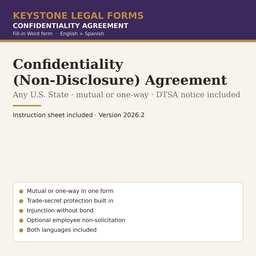
Non-Disclosure Agreement (NDA) Template — Any State
Mutual or one-way, with the Defend Trade Secrets Act notice and an injunction clause. 51 state editions, each citing its trade-secrets act.
Who it is for
Two businesses, or a business and a consultant, investor or prospective buyer, about to share financial, technical or customer information for a defined purpose.
What is inside
- Confidentiality Agreement: Key Terms table (mutual or one-way, purpose, disclosure and confidentiality periods, optional non-solicitation) + 7 articles — what is confidential, obligations, return or destruction, trade secrets, no obligation to proceed, remedies including injunction, general
- Instruction Sheet: mutual vs one-way, what counts as confidential, who may see it, remedies, after-signing practice (marking, log), when the form is not enough
The first pages
Rendered from the actual form. Yellow fields are the ones you fill in; the rest is already written.
CONFIDENTIALITY AGREEMENT
The information in this table is incorporated into the Agreement that follows. Where the Agreement refers to an item "in the Key Terms," it means the entry below.
| Item | Entry |
|---|---|
| Party A — name, entity type and address | [PARTY A NAME] · [PARTY A ENTITY TYPE AND ADDRESS] |
| Party B — name, entity type and address | [PARTY B NAME] · [PARTY B ENTITY TYPE AND ADDRESS] |
| Direction of disclosure | [TYPE "Mutual — each party may disclose to the other" OR "One-way — only Party A discloses; Party B is the Recipient"] |
| Purpose of the disclosures | [PURPOSE OF DISCLOSURE — e.g., "evaluating a possible purchase of Party A's business" or "Party B's performance of consulting services for Party A"] |
| Effective date | [EFFECTIVE DATE] |
| Period during which disclosures are covered | [DISCLOSURE PERIOD — e.g., "two (2) years from the effective date"] |
| How long the obligations last after each disclosure | [CONFIDENTIALITY PERIOD — e.g., "three (3) years"] — and, for trade secrets, for as long as they remain trade secrets |
| Non-solicitation of employees | [TYPE "None" OR "Yes — for" AND THE NUMBER OF MONTHS "months after the effective date"] |
| Governing law and courts | State of [GOVERNING LAW STATE]; state or federal courts located in [COUNTY AND STATE FOR LAWSUITS] |
This Confidentiality Agreement (the "Agreement") is made on the effective date stated in the Key Terms between the two parties identified there. If the Key Terms state that disclosure is mutual, each party is a "Discloser" when it discloses information and a "Recipient" when it receives it. If the Key Terms state that disclosure is one-way, Party A is the only Discloser and Party B is the only Recipient, and the obligations below bind Party B alone. The parties expect to exchange information for the purpose stated in the Key Terms (the "Purpose") and agree as follows.
1.1 Confidential Information. "Confidential Information" means every piece of information, in any form — spoken, written, electronic, visual or by inspection of premises or things — that a Discloser or anyone on its behalf makes available to the Recipient during the disclosure period stated in the Key Terms, in connection with the Purpose, and that (a) is marked or identified as confidential at the time of disclosure, (b) is confirmed in writing as confidential within fifteen (15) days after a spoken or visual disclosure, or (c) a reasonable person in the Recipient's position would understand to be confidential from its nature or the circumstances of its disclosure. It includes, without limitation, business plans, financial statements and projections, customer, supplier and employee information, prices and costs, contracts, products and services under development, software and source code, formulas, processes, know-how, and the fact that the parties are discussing the Purpose, and it includes notes, analyses and other materials the Recipient prepares that contain or reflect such information.
1.2 What Is Not Confidential. Confidential Information does not include information that the Recipient can show by written records (a) was lawfully known to the Recipient before the Discloser disclosed it, without any obligation of confidence; (b) is or becomes publicly available through no breach of this Agreement by the Recipient; (c) is lawfully received by the Recipient from a third party that was free to disclose it; or (d) is developed by the Recipient independently, without use of or reference to the Discloser's Confidential Information. Information is not excluded merely because parts of it are public or because it is combined with public information.
1.3 Trade Secrets. Confidential Information that qualifies as a trade secret under the trade secrets statute of the state whose law governs this Agreement or under the federal Defend Trade Secrets Act of 2016 (18 U.S.C. § 1836 et seq.) remains protected for as long as it remains a trade secret, even after the confidentiality period in the Key Terms ends.
2.1 Use Only for the Purpose. The Recipient will use Confidential Information only for the Purpose, and for nothing else — not to compete with the Discloser, not to solicit its customers or employees, and not to develop products or services that use it.
2.2 Keep It Confidential. The Recipient will hold Confidential Information in strict confidence, will protect it with at least the care it uses for its own confidential information and in no case less than reasonable care, and will not disclose it to anyone except as Section 2.3 allows.
2.3 Who May See It. The Recipient may disclose Confidential Information only to its own officers, employees, directors, members, and its professional advisers, lenders and financing sources (its "Representatives") who need to know it for the Purpose and who are bound, by written agreement or professional duty, to confidentiality obligations at least as protective as these. The Recipient is responsible for every act or omission of its Representatives that would breach this Agreement if done by the Recipient. The Recipient will not disclose Confidential Information to any other third party without the Discloser's prior written consent.
2.4 No Copying or Reverse Engineering. The Recipient will not copy Confidential Information except as reasonably needed for the Purpose, will reproduce every confidentiality marking on any copy, and will not reverse engineer, disassemble or decompile any prototype, software, device or sample that embodies Confidential Information.
2.5 Notice of Unauthorized Use. The Recipient will notify the Discloser in writing promptly on learning of any unauthorized use or disclosure of Confidential Information, and will cooperate with the Discloser in recovering it and preventing further unauthorized use.
2.6 Compelled Disclosure. If the Recipient is required by law, regulation, subpoena or court order to disclose Confidential Information, it may do so only after giving the Discloser prompt written notice (where legally permitted) so that the Discloser may seek a protective order, after cooperating reasonably with the Discloser's efforts to limit the disclosure, and only to the extent legally required. Information so disclosed remains Confidential Information for every other purpose.
3.1 On Request or at the End. Within ten (10) days after the Discloser's written request, or after the Purpose has been completed or abandoned, the Recipient will return to the Discloser or destroy, at the Discloser's choice, every document and other tangible thing that contains Confidential Information, will permanently delete every electronic copy, and will certify in writing that it has done so.
3.2 Exceptions. The Recipient may retain one archival copy, in the custody of its legal counsel, solely to confirm its compliance with this Agreement, and may retain copies that an automatic electronic backup system has created and that are not readily accessible, provided that every retained copy remains subject to this Agreement for as long as it exists.
4.1 Disclosure Period. This Agreement covers disclosures made during the period stated in the Key Terms. Either party may end that period earlier by written notice to the other.
4.2 Confidentiality Period. The Recipient's obligations with respect to each piece of Confidential Information continue for the confidentiality period stated in the Key Terms, counted from the date it was disclosed, and — for trade secrets — for as long as the information remains a trade secret. Ending the disclosure period does not shorten the confidentiality period.
5.1 Ownership. Confidential Information remains the property of the Discloser. This Agreement gives the Recipient no license or other right in it, or in any patent, copyright, trademark or trade secret of the Discloser, except the limited right to use it for the Purpose.
5.2 No Warranty. The Discloser provides Confidential Information "as is." It makes no representation about its accuracy or completeness and has no liability for the Recipient's use of it, except as the parties may agree in a later definitive agreement.
5.3 No Obligation to Proceed. Neither party is obliged by this Agreement to disclose any particular information, to enter into any transaction or further agreement, or to continue discussions. Either party may stop at any time.
5.4 Non-Solicitation. If the Key Terms provide for it, then for the period stated there each Recipient will not, directly or through others, solicit for employment or engagement any employee of the Discloser with whom the Recipient had contact in connection with the Purpose; general advertisements not directed at the Discloser's employees are not solicitation. If the Key Terms state "None," this Section does not apply.
… the document continues for about 5 pages.
The instruction sheet
Every download includes a plain-language instruction sheet. This is how it opens.
INSTRUCTION SHEET
Confidentiality (Non-Disclosure) Agreement
A confidentiality agreement (also called a non-disclosure agreement or NDA) is signed before one business shows another something it does not want repeated: its financial statements to a prospective buyer or investor, its customer list to a marketing consultant, its product plans to a supplier, its software to a developer. The agreement defines what is confidential, limits what the recipient may do with it, says who may see it, and provides remedies — including an injunction — if it leaks. It also protects trade secrets under state trade secrets law and the federal Defend Trade Secrets Act, both of which require the owner to have taken reasonable measures to keep the information secret; a signed NDA is the clearest such measure.
Mutual or one-way. The Key Terms let you choose. A mutual agreement treats both parties the same and is used when both will share information (two companies exploring a joint venture, a buyer and a seller who will each see the other's books). A one-way agreement is used when only one party discloses (a company and a consultant, a company and a prospective employee or investor).
Use this form if: the parties are businesses or individuals exchanging information for a defined purpose, and no other agreement between them already covers confidentiality.
Use a different form if: the recipient is an employee (the confidentiality provisions in Form US-EMP-01 are drafted for employment), an independent contractor already engaged under Form US-GEN-02 (which contains its own confidentiality article), or the disclosure is of personal data subject to privacy laws (health information, consumer financial data), which needs specific terms.
• Work in Microsoft Word (or any program that opens .docx files). Every field appears in yellow highlight inside square brackets, for example [PARTY A NAME]. Replace the whole bracket — including the brackets themselves — with your information, and remove the yellow highlight (select the text, then Home → Text Highlight Color → No Color).
• Some fields offer choices, written as "OPTION A" OR "OPTION B", or begin with the word TYPE followed by the alternatives. Pick one, type that text in place of the entire bracket, and delete the alternatives.
• Use the search function (Ctrl+F) to search for an opening square bracket when you are done. Dates: write them in full ("March 3, 2026"). Delete the cover page before signing.
State editions
All 51 editions are in the same download. Open a state to see what its edition already fills in.
AL · AK · AZ · AR · CA · CO · CT · DE · DC · FL · GA · HI · ID · IL · IN · IA · KS · KY · LA · ME · MD · MA · MI · MN · MS · MO · MT · NE · NV · NH · NJ · NM · NY · NC · ND · OH · OK · OR · PA · RI · SC · SD · TN · TX · UT · VT · VA · WA · WV · WI · WY
Questions
What file do I get?
A zip with the state-neutral form and all 51 state editions as Word (.docx) files in English and Spanish, plus the Instruction Sheet. Open in Microsoft Word, Google Docs or LibreOffice.
How do I complete it?
Open the Instruction Sheet first. Replace each yellow [BRACKETED FIELD] with your information, delete the options you do not use, delete the cover page, then print or e-sign.
Can I reuse it?
Yes. The license covers your own business and every company you own; it does not allow resale of the template itself.
Do I need a notary or a lawyer?
The Instruction Sheet says when a signature needs a notary and lists the situations where the form is not enough and an attorney should review it.
Refunds?
Digital downloads are final once delivered. The preview on this page is taken from the actual document so you can see what you are buying.